[ Signal diagnosis · 6 min read ]
Alternator D+ signal not reaching the Elektroblock
Your motorhome charges perfectly on 230 V mains but when driving on the road the auxiliary battery doesn't go up. The problem is almost always the alternator D+ signal not reaching the Elektroblock. Here's the 10-minute diagnosis.
What D+ actually is
D+ is a signal line coming from the alternator’s control circuit (or, on more modern alternators, from the engine ECU) that goes high (approximately 13-14 V) only when the engine is running and the alternator is producing output. It drops to 0 V when the engine stops.
The Elektroblock reads this signal to decide whether to energise the coupling relay and connect the starter battery with the auxiliary one. No D+, no coupling, no charging while driving.
10-minute diagnosis with a multimeter
Step 1: measure D+ at the alternator
Start the engine and let it idle. Open the engine bay. Locate the alternator and the D+ terminal (small spade or screw-on, usually a thin yellow or blue wire). Probe it in DC against a chassis ground point.
- Expected: 13.8-14.4 V.
- 0 V with engine running: alternator fault, not an EBL issue. Common on 10+ year old alternators. Garage job.
Step 2: measure D+ at the Elektroblock
Keep the engine running. Access the EBL’s Block 2 connector. Identify the D+ pin (typically yellow wire, specific pin position depends on EBL model — the manual shows it).
- Expected: 12-14 V (slightly lower than at the alternator due to wire resistance).
- 0 V while the alternator shows 13.8 V: wire is cut or 2 A fuse has blown.
Step 3: find the 2 A D+ fuse
Between the alternator and the Elektroblock, almost all motorhomes fit a 2 A fuse in the engine bay. Common locations:
- Fiat Ducato / Peugeot Boxer / Citroën Jumper: on the small fuse block on the right-hand side of the engine, inside a small black box.
- Mercedes Sprinter: in the main fuse box on the firewall.
- Ford Transit: on a dedicated fuse block under the driver’s seat on some campervan conversions.
If the fuse is blown, replace with a 2 A fast-blow fuse. If it blows again, there’s a short on the wire between fuse and EBL (abraded insulation touching chassis). Repair the wire first.
Common secondary causes
Modern “smart” alternators. On Euro 6 vehicles, the alternator may stop producing D+ to save fuel when the ECU decides. Workaround: a dedicated DC-DC battery-to-battery charger (Victron Orion, CTEK D250 etc.) replaces the EBL’s reliance on D+. The EBL still works but no longer handles the charging-while-driving channel.
Old alternator with worn brushes. The alternator produces 13-14 V intermittently. The EBL sees random D+ values and the coupling relay chatters. Audible symptom: metallic buzz from the EBL when engine idle changes.
Workshop repair
This fault is not inside the Elektroblock in most cases. It’s in the engine wiring, in the 2 A fuse, or in the alternator itself. There’s nothing to send for repair.
However, if measurement 2 shows that D+ reaches the EBL correctly and charging still doesn’t happen while driving, the fault is in the EBL’s logic that reads D+. In that case, bench diagnosis required and repair between €100 and €140.
Related guides
- Auxiliary battery not charging — complete charging-fault matrix.
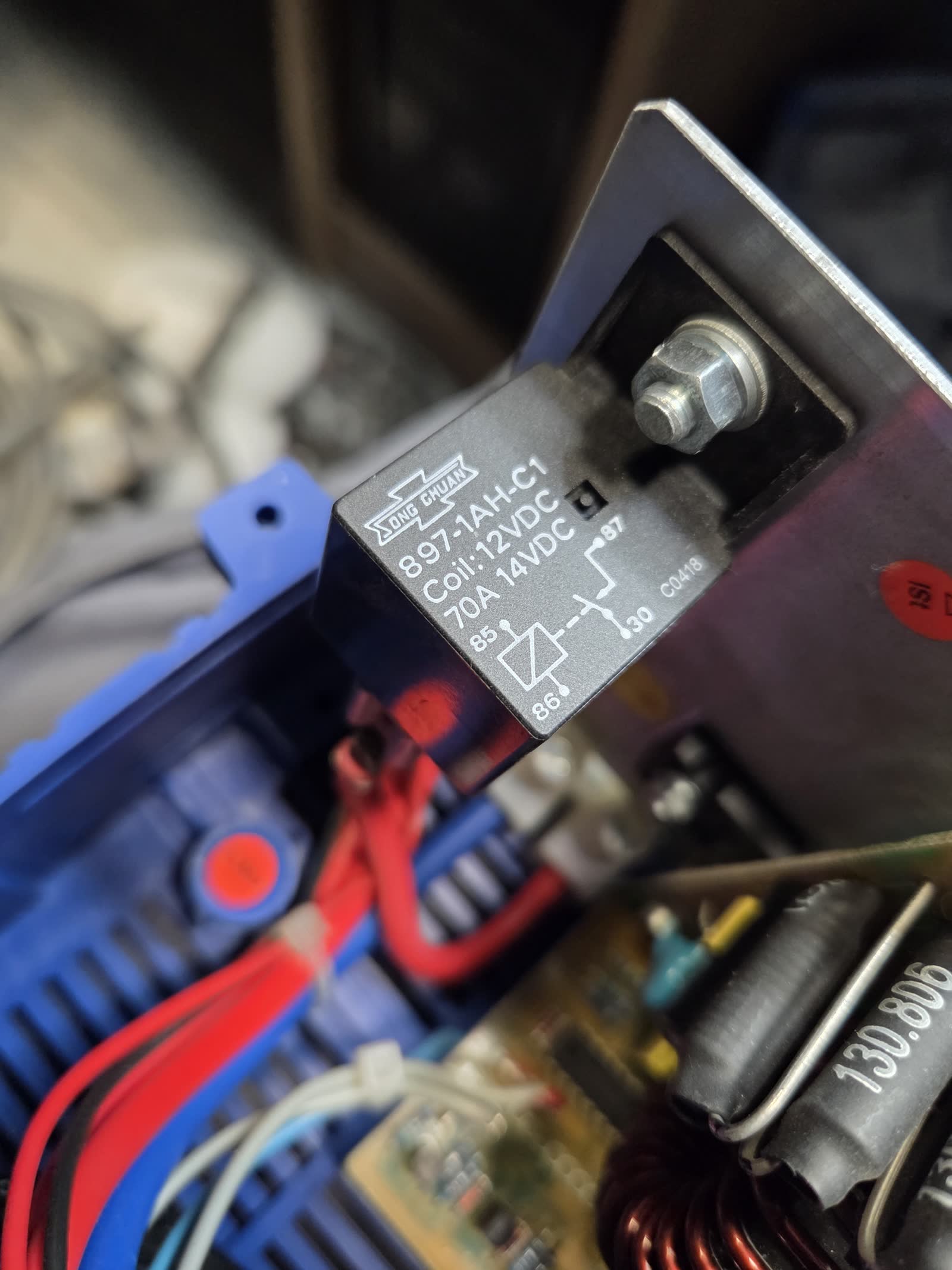
- 70 A coupling relay — once D+ arrives, this is the next component in the chain.
- 12 V button not activating — if the LT panel is also acting up.
Read next
Other related faults.
Charging diagnosis
Elektroblock not charging the auxiliary battery
If your Schaudt Elektroblock has stopped charging the living-area battery —neither from 230 V mains, nor from the alternator, nor from the solar panel— the fault is almost always in one of these seven points. This guide shows you how to diagnose which before dismantling anything.
Read guide →
Internal components
70 A coupling relay burnt inside the Elektroblock
The 70 A relay that connects the starter battery with the auxiliary one during driving charging is the component that fails most often in Schaudt Elektroblock units. It buzzes, sticks or stays open: three symptoms, one culprit. Here's when to replace it and how much it costs.
Read guide →
Signal diagnosis
Elektroblock doesn't activate when you press the 12 V button
You press the 12 V switch on the LT panel and nothing happens. No living-area lights, no water pump, no ventilation. This step-by-step diagnosis goes from the easiest check (panel fuses) to the most technical (internal EBL logic) to find what's breaking the activation chain.
Read guide →
Next step
Time to repair? Free diagnosis by WhatsApp.
Send me the exact Elektroblock model and a photo of the LT panel. I'll confirm whether it's a common fault, the indicative price and how to pack it.
Message on WhatsApp